Texas’s fragmented bail system lacks oversight, allowing bondsmen to profit while repeat offenders cycle through release with little accountability. Statewide regulation would strengthen enforcement, improve data transparency, and better protect public safety across counties.
Key Points
- The current regulations for bondsmen in Texas provides limited oversight and a lack of consistency, leading to incongruous enforcement of the law, diminished capacity for collecting forfeitures, and an absence of accountability.
- Although the bail bondsmen provide an avenue to release for those who cannot afford to pay their bond in full, their lack of accountability leads to the release of violent offenders repeatedly, putting profit over public safety.
- The majority of states have a centralized bail bondsman oversight mechanism, while Texas still relies on individualized, county bail bond systems.
- The current system places the financial oversight, consumer protections, and market regulation responsibilities on institutions that are not equipped to effectively perform them—reinforcing the need for a more centralized, professionalized regulatory framework.
Executive Summary
The current state of regulations for bondsmen in Texas provides limited oversight and a lack of consistency, leading to incongruous enforcement of the law, diminished capacity for collecting forfeitures, and an absence of accountability. Although the bail bondsmen provide an avenue to release for those who cannot afford to pay their bond in full, their lack of proper oversight leads to the release of violent offenders repeatedly, rarely with any enforcement of penalties to the bondsmen, thereby putting profit over public safety.
At their core, bail bondsmen are intended to act as sureties, or insurance agents, for the defendants they are bonding out, including providing oversight to a defendant’s activities, as they have a financial incentive to ensure the defendant shows up to court. In the ideal, acting as a surety would require some level of assessment of a defendant’s risk prior to agreeing to act as their surety. However, with a lack of bond forfeiture enforcement, there is little incentive for oversight of the defendant, and it actually provides a perverse incentive by making it profitable for the defendant to reoffend as they can once again bond them out.
Currently, Texas Occupations Code, Chapter 1704, requires counties with populations of 110,000 to establish a County Bail Bond Board. This board is responsible for establishing both local regulations and the oversight of those regulations. This creates a non-standardized system of accountability throughout the state, as well as a lack of data on bond forfeitures, re-offense rate per company, and failure to appear rate per company. This also creates a system where a bonding company may be under investigation in one county, while simultaneously being in good standing and operating freely in another.
Moving the regulation of bondsmen to the state-level—preferably to be housed in the Texas Department of Insurance (TDI)—would provide greater resources to enforce regulations, as the department is already responsible for protecting Texans from predatory financial practices. Additionally, there would be no disconnect when managing companies that operate in multiple counties and are not held accountable for illegal practices. Finally, data collection would be more easily compiled to improve accountability.
Introduction
To understand how the bail bondsmen operate within the criminal justice system, one must first understand the pretrial process more generally. Following an arrest, a judge or magistrate determines which type of bail (or lack thereof) is appropriate for the defendant, following a review of their criminal history and current case circumstances. A magistrate has the option to release the defendant on a personal bond, a cash bond, or, in high-risk cases, to deny pretrial release and detain the defendant while they await trial.
When a judge sets a cash bail for a person to obtain pretrial release, this cash bail acts as an accountability mechanism and an agreement to appear in court following a defendant’s release. The defendant then has two options: 1) pay the cash bail in full to the court, which they will then be reimbursed for once they appear in court, or 2) use a bail bond company to act as their surety.
Common terms defined (Texas Department of Insurance, 2026):
- Bail: The security given by the accused that he will appear and answer before the proper court the accusation brought against him, and includes a bail bond or a personal bond (Texas Code of Criminal Procedure, Chapter 17).
- Bail bond: A cash deposit, or similar deposit or written undertaking, or a bond or other security, given to guarantee the appearance of a defendant in a criminal case (Texas Occupations Code, Chapter 1704).
- Bail bond surety: Refers to a person who (A) executes a bail bond as a surety or co-surety for another person; or (B) for compensation deposits cash to ensure the appearance in court of a person accused of a crime (Texas Occupations Code, Chapter 1704).
- Bonding business: The solicitation, negotiation, or execution of a bail bond by a bail bond surety.
When using a bonding company, the defendant enters into an agreement with the company that includes paying a small, non-refundable down payment (typically around 10% of the bail amount) in exchange for the bonding company acting as the guarantor for the defendant’s release. This agreement may also include conditions of release, such as regularly meeting with a bonding agent, in addition to the fee. However, this is individual and inconsistent for each bonding agent/company, and there are no statutory requirements to report a company’s requirements, down payment minimums, payment plans, or the like.
A bonding company or agent can either pay the bond in full or use collateral to obtain the defendant’s release. Traditionally, the bondsman would be held liable to pay the bond in full to the court if the defendant failed to appear for their court date, a condition known as a bond forfeiture.
The bond forfeiture process operates according to the civil court system. Unfortunately, there is limited data on how often bond forfeitures occur. Currently, the Office of the Attorney General reports the total dollar amounts forfeited to the state, but does not distinguish between which types of forfeitures (i.e., bond forfeitures vs. civil asset forfeitures) these dollars are derived from (Office of the Attorney General, 2024).
It is likely that bond forfeitures are inconsistently enforced across counties. In fact, there have been historical investigations into the lack of bond forfeitures for defendants failing to appear; these investigations found millions of unpaid dollars from bail bondsmen in Texas counties (Dallas Morning News, 2011; Olsen, 2010; Sawyer, 2022). Furthermore, in 2025, the Chairman of the Harris County Bail Board, Troy McKinney, told the Houston Chronicle that he believes bond forfeitures are only occurring “less than 1%, maybe 1%” of the time” (Satija, 2025, para. 11). When a bond forfeiture does occur but is not paid, one way to hold the company accountable is by suspending the agents’ authority to write further bail bonds; unfortunately, there is no data to confirm how often this is being enforced.
Additionally, if a bondsman is concerned about a client’s re-arrest or potential failure to appear, the bondsman can file a surrender affidavit to ensure that they will not have to undergo a forfeiture by releasing the defendant as their client. A recent legislative proposal from 2025 would require bondsmen to notify prosecutors if they file a surrender affidavit; however, the legislation did not receive a hearing (SB 2219, 2025).
There is currently no accountability for bondsmen if their client re-offends, as it is a separate process from failing to appear. In fact, Ken Good, a board member of the Professional Bondsmen of Texas, was quoted as saying the bondsmen are “guaranteeing an appearance; we’re not guaranteeing good citizenship” (Satija, 2025, para. 15). While many bail bondsmen claim to monitor their defendants closely, monitoring is not required by law, nor do they have to report on their monitoring activities.
These combined factors—lack of accountability for re-offending, the ability to easily surrender a client, failure to enforce bond forfeitures, and a lack of uniform reporting requirements—create a market and environment where bail bondsmen have very little risk when undertaking a client.
Financial Nature of Bail Bond Industry
While the bail bond industry exists and operates as a component of the criminal justice system, it functions more similarly to the insurance and financial risk management industries. The bail bond industry:
- Underwrites risk by considering a defendant’s criminal record, flight risk, and other criminogenic risk factors.
- Posts and manages collateral to back bonds.
- Collects non-refundable down-payments, similar to insurance premiums.
- Is held liable for defendant’s behavior (e.g., failing to appear) and is subject to bond forfeitures, resulting in steep financial penalties.
- Employs bounty hunters to recover losses.
Despite similarities with industries such as insurance, financial services, or surety bond underwriting, bail bond companies continue to be governed by local and administrative rules rather than a centralized, statewide framework, with very little consistency and uniformity across counties.
Furthermore, bail bondsmen are not required to disclose their profits. And while aggregated data is lacking across the state, the Harris County Bail Dashboard does track the dollar amounts top-grossing bondsmen are putting up in the county. In 2025, the top bondsmen had bailed out defendants for a total of $106 million (Harris County Bail Dashboard, n.d.).
Current Texas Regulatory Framework
Despite similarities to traditional insurance agency activities, the TDI does not regulate bail bonds, with one exception: According to Section 2301, Texas Insurance Code, TDI does oversee complaints regarding forfeiture or collateral refunds for bonds involving a corporate surety (Texas Department of Insurance, 2026). In the 63rd Texas Legislature, SB 383 (1973), often referred to as the 1973 “Bail Bondsman Act,” established the original regulatory framework for executing bail bonds in Texas. As described in the Act, the legislative intent was to provide “reasonable regulation” while preserving the right to bail for the accused.
For counties with a population of over 110,000, a bail bond board must be established to oversee bail bond business (Tex. Occupations Code, Chapter 1704). For counties with fewer than 110,000, the board is discretionary. The Professional Bondsmen of Texas lists 76 counties with active bail bond boards (Professional Bondsmen of Texas, n.d.).
The board is responsible for the licensing of bail bond sureties and agents. If a county does not have an established bail bond board, an “individual must obtain a general lines property and casualty agent license from TDI to represent a corporate surety” (Texas Department of Insurance, 2026).
The board has administrative authority to supervise and regulate the bonding industry in its county, including adopting rules, conducting investigations regarding issuance, denial, or renewal of licenses, and issuing and denying licenses to applicants. The county board must be composed of (Tex. Occ. Code, Sec. 1704.053):
- The sheriff or sheriff’s designee who is the sheriff’s administrator or a deputy sheriff, ranked at a minimum of sergeant;
- A district judge with jurisdiction over criminal matters or a designee;
- The county judge, a designee from the commissioners court, or a designee approved by the commissioners court
- A licensed bail bond surety or agent for a corporate surety in the county elected under Section 1704.0535, or a bail bond surety or agent for a corporate surety licensed in the county who is designated by the elected surety or agent;
- A justice of the peace;
- The district clerk of the clerk’s designee;
- The county clerk or the clerk’s designee, if responsible for criminal matters;
- If appointed by the board, a presiding judge of a municipal court;
- If the county’s principal municipality designates a presiding judge in the municipal court system, the presiding judge or a municipal judge from the system designated by the presiding judge;
- The county treasurer or the treasurer’s designee or, if appointed by the commissioners court in a county that does not have a county treasurer, the person designated by the county commissioners court to perform the duties of the county treasurer; and
- A criminal defense attorney practicing in the county and elected by other attorneys whose principal places of business are located in the county and who are not legally prohibited from representing criminal defendants or the designee of the criminal defense attorney.
While the 1973 Bail Bondsman Act may have been an appropriate mechanism for regulation at the time, this structure may no longer be serving in the best interest of public safety and for defendants due to population growth, bail bond volume, and variations across counties. This decentralized system was originally designed with a much smaller population in mind, resulting in fewer bail bond boards. When the Bail Bondsman Act was enacted, Texas’s population was approximately 12,000,000 (Texas State Library and Archives Commission, n.d.); in 2025, the population had risen by nearly 166%, reaching almost 32,000,000 (World Population Review, n.d.). In 1970, only 15 of Texas’s 254 counties had over 110,000 people: Bell, Bexar, Cameron, Dallas, El Paso, Galveston, Harris, Hidalgo, Jefferson, Lubbock, McLennon, Nueces, Tarrant, Travis, and Wichita (Texas Almanac, n.d.). As of 2026, Texas now has approximately 40 counties with a population over 110,000, and as mentioned, Texas currently has about 76 active county bail boards (Texas Demographics, 2026; Professional Bondsmen of Texas, n.d.).
County Oversight Challenges
While county bail bond boards were intended to provide local independence and oversight, the boards have led to a system that is riddled with inconsistencies, a lack of accountability, and vulnerability to local pressures. Boards often lack the institutional capacity, independence, and uniform standards to regulate the statewide financial risk industry in which the bail bond industry operates.
Inconsistent Standards
As the boards operate independently, this creates an environment of differing standards, even among similarly situated jurisdictions. For example, in 2022 the Harris County Bail Bond Board voted to enact a policy that requires a 10% minimum down payment for defendants seeking release through a bondsman for certain violent offenses (Marley, 2022).
Supporters argued that this would provide judges with insight and consistency when determining the dollar amount to set a bond and reduce the number of violent individuals released. Others (including board members), however, argued that this may not be in the scope of local authority. Ken Good, a board member of the Professional Bondsmen of Texas, stated, “If you want to set what we can charge, that should be done at the Texas Legislature, not here” (Harab & DeBenedetto, 2022).
This action highlights a core challenge of county bail bond boards: boards are making quasi-legislative decisions affecting statewide market behavior, despite lacking the expertise or uniformity associated with state-level regulators. This creates a patchwork of regulation across the state as local boards attempt to address concerns, which also creates difficulties for bondsmen operating in multiple counties as they attempt to navigate conflicting rules and regulations.
Failure to Act Against High-Risk or Controversial Licensees
County bail boards have also faced criticism for failing to take action against bad actors, despite pubic safety concerns. In 2022, many victim advocates spoke out against the Harris County Bail Bond Board when the board refused to decline to renew a bail bonding license for Wisam Muharib. Muharib’s bonding company was accused of bonding out a defendant who was charged with the murder of a Harris County Deputy Constable, Omar Ursin, for less than 10% and offering him a payment plan (Wallace, 2022).
Victim advocates in attendance claimed the board was “not doing their job” and failed to use the opportunity to send a message to the bail bond industry—with the fear that this would lead to future victims ending up “in the same predicament as Deputy Ursin and his family” (Wallace, 2022).
Concerns about licensing are not limited to Harris County. In 2017, the Bexar County Bail Bond Board renewed AA Best Bail Bonds’ license, despite accusations of unethical practices, including hiring employees who were not licensed to do bail bonds, and a Notice of Federal Tax Lien from the Internal Revenue Service. The notice documented that the owner of AA Best Bail Bonds owed more than $1.9 million in federal taxes (Garcia, 2017).
These cases illustrate how local boards may be hesitant to impose discipline, despite public safety concerns, particularly when discipline could affect established industry heads within their jurisdiction. This also raises the question of whether local boards have the financial auditing expertise to evaluate complex financial risk and misconduct, as well as whether boards are consistently prioritizing financial integrity and compliance.
Lack of Enforcement of Financial Obligations
One of the most consistent and documented challenges in the current system is the failure to collect bond forfeitures. In 2011, an investigation by The Dallas Morning News found bail bondsmen in Dallas County owed approximately $35 million in uncollected default judgments (Dallas Morning News, 2011). Likewise, in 2010, The Chron found more than $26 million in bond forfeitures were left unpaid in Harris County, spanning across hundreds of current and former bond companies, with some dating back decades (Olsen, 2010). While these investigations are more than a decade old, the issue likely remains widespread, as current estimates suggest that approximately 1% of bond forfeitures occur (Houston Chronicle, 2025).
This lack of enforcement directly impacts taxpayers and undermines the integrity of the bail system, demonstrating that county-level enforcement mechanisms are likely insufficient to ensure compliance with financial obligations, thereby allowing massive sums to go uncollected. Unfortunately, due to the current lack of statewide reporting requirements, it is difficult to determine the dollar amount of unpaid forfeitures bondsmen may owe to the state.
Board Structural Limitations
These prior examples emphasize the broader structural limitations of the current system:
- Lack of Ethical Safeguards: County boards include industry participants and local officials, opening up the board to potential conflicts of interest.
- Limited Capabilities: Counties are not equipped to conduct sophisticated financial audits or enforce compliance standards, particularly for companies that operate in multiple counties.
- Inconsistent Enforcement: Disciplinary actions and licensing decisions vary widely across jurisdictions.
- Weak Financial Recovery: Counties fail to collect forfeitures and enforce judgments.
- Exposure to Local Pressure: High-profile or controversial decisions may be influenced by politics, resource constraints, or personal relationships.
These challenges are the result of a decentralized regulatory structure applied to a complex, multi-county financial industry. The current system places the financial oversight, consumer protections, and market regulation responsibilities on institutions that are not equipped to effectively perform them—reinforcing the need for a more centralized, professionalized regulatory framework.
National Regulatory Framework
States That Have Completely Outlawed Bail Bondsmen
In the 1960s and 1970s, alongside landmark Supreme Court decisions such as Gideon v. Wainwright (1963) and Miranda v. Arizona (1966), federal and state governments began scrutinizing the procedural rights of defendants, such as the right to counsel and other pretrial protections. Gideon v. Wainwright established indigent defendants’ right to an attorney in state criminal matters; Miranda vs. Arizona guaranteed that law enforcement officers must read individuals their constitutional rights before being detained. These decisions helped spread a broader movement of criminal justice reforms across the nation, including the abolishment of commercial bail bondsmen in some jurisdictions. Today, commercial bondsmen are prohibited in Illinois, Kentucky, Oregon, Wisconsin, and Massachusetts.
Illinois
In 1963, Illinois became one of the first states to abolish bail bondsmen by amending the state’s Code of Criminal Procedure (Illinois Courts, n.d.). Historically, Illinois used a 10% deposit bail system in which defendants could post 10% of the bail amount with the court, rather than relying on a third party like the commercial bondsmen (The Civic Federation, 2022). This allowed the state to maintain a financial mechanism to ensure court appearances while eliminating a middleman. In 2021, Illinois abolished cash bail with the passage of the SAFE-T Act, which was a sweeping criminal justice reform act that had policy implications for policing, pretrial, sentencing, pre-arrest diversion, and corrections (Illinois Criminal Justice Information Authority, 2021). Illinois was the first state to abolish cash bail completely in favor of a pretrial release system in which judges rely on nonmonetary release conditions to ensure court appearance (Illinois Criminal Justice Information Authority, 2021).
Kentucky
The Kentucky Bail Reform Act of 1976 explicitly outlawed commercial bondsmen in the state (Travis, 2020). Instead, Kentucky courts utilize both financial and nonfinancial release mechanisms that do not require a middleman to ensure court appearance. In Kentucky, there are three financial options for release, including cash, property, and partially secured bonds (Kentucky Court of Justice, n.d.). With a cash bond, a defendant or someone acting on their behalf posts the full amount of cash bail. If they appear in court and do not violate their conditions, the amount is refunded when the case is closed. If the defendant fails to appear or violates conditions of release, the full amount is forfeited. With the property option, an individual can have a lien placed on their property to secure bail, giving the lien creditor the right to seize the property if the defendant fails to appear or violates release conditions. The individual’s equity in the property must be at least twice the bail amount. If the defendant violates the conditions or fails to appear in court, the court can order the property to be forfeited. The partially secured bond option requires a deposit of a percentage of the bail amount, typically 10%. If the defendant appears in court and complies with the conditions, the deposit is returned, less a 10% processing fee. If the defendant fails to appear or violates the conditions of bail, the full bail amount may be forfeited to the court (Kentucky Court of Justice, n.d.).
Oregon
In 1978, the Oregon Supreme Court effectively prohibited bail bondsmen from operating in the state by outlawing the practice of bounty hunting (State v. Epps, 1978). Bonds are instead handled by the court and are referred to as security releases (Judicial Department of the State of Oregon, n.d.). With this system, a defendant pays 10% of the amount as a down payment to the court. A 15% fee is collected from the 10% to cover court processing fees. If the defendant fails to appear, bond forfeiture proceedings are commenced. This system, like those in the aforementioned states, eliminates the need for private bondsmen while still maintaining a structured financial incentive for court compliance.
Wisconsin
Wisconsin banned commercial bail bondsmen outright in 1979 (Cohen, 2019). The state does not allow commercial bondsmen establishments and instead uses statutory bond types and conditions rather than licensed professionals. Judges can require an appearance bond with solvent sureties or allow cash instead (Wisconsin Bail Code, Ch. 969). Sureties are required to be Wisconsin residents, and courts can require proof of financial sufficiency. Wisconsin also has 10% cash deposit option in certain circumstances, further emphasizing its court-based approach to pretrial release (Wisconsin Bail Code, Ch. 969).
Massachusetts
The State of Massachusetts prohibits commercial surety operations and, therefore, for-profit bondsmen do not exist. Instead, the bail is handled directly between courts and defendants (NCSL, 2016). Defendants can either post bail with the court or be released on personal recognizance, depending on the circumstances of the case (Massachusetts Code, Sec. 58). The Massachusetts model emphasizes judicial discretion and non-monetary pretrial release over commercial and monetary release options.
States Where Bondsmen are Severely Restricted or a Functioning Commercial Bondsmen Industry Does Not Exist
Some states, rather than statutorily prohibiting commercial bond firms outright, have simply developed bail bond systems that function without the need for bondsmen or use them only in a very limited capacity. Maine, Nebraska, and New Jersey have all opted for this model.
Maine
Maine does not have a commercial bail bond system, and there are no private, commercial bondsmen businesses. Bail can be secured through cash or the property of the defendant (or a third party acting as a surety) (Maine Bail Code, Ch. 105, Sec. 1074). The Bail Code in Maine allows for private sureties, which are people or entities who promise the appearance of defendants. A surety can provide a sworn statement demonstrating their ability to pay the obligation, and can be required to prove resources (such as real estate) (Maine Bail Code, Ch. 105, Sec. 1071). Maine statutes govern the responsibilities of a surety and the termination of cash bail/surety agreements.
Nebraska
The State of Nebraska does not maintain a functioning commercial bail bond system and relies on court-administered pretrial release (State of Nebraska Judicial Branch, 2019). Pretrial release options in Nebraska include a personal recognizance bond, which requires no monetary payment, and percentage bonds, where a defendant pays a bond amount, 10% of which goes to the court and 90% of which is returned if a defendant appears as required (Nebraska Revised Statute 29-901). Like Maine and New Jersey, this model emphasizes a direct bail system between courts and defendants.
New Jersey
In 2017, New Jersey implemented a large criminal justice reform package that shifted the state’s bail system from one that primarily relies on monetary bail to one that relies on a more objective, risk-based system (New Jersey Courts, n.d.). Judges in the state now focus on a defendant’s risk of flight and evading court hearings rather than the defendant’s ability to pay, thereby emphasizing public safety over wealth. In most cases, defendants are released before trial on conditions rather than paying bail to the court or using a bondsman.
States Where Bondsmen Are Regulated Statewide
Most states regulate bail bond businesses and agents through state agencies or boards. The exceptions are states that have prohibited commercial bondsmen operations (and thus do not need regulation) and states that opt to regulate bondsmen at the local level. Two states, Georgia and Texas, currently regulate their commercial bondsmen at the county level (NCSL, 2013).
States that choose to regulate bail bondsmen through insurance departments, labor departments, or boards treat bail bond businesses more as financial risk instruments rather than purely criminal justice tools. Alabama, Alaska, Colorado, Delaware, Idaho, Pennsylvania, and Ohio exemplify this regulatory model.
Alabama
Alabama licenses bondsmen through the Alabama Professional Bail Bonding Board (APBB), established under the state’s bail bond regulation act (Alabama Professional Bail Bonding Board Law, Section 15-13-201). Under state law, a bail bond posted by a bondsman is a surety obligation guaranteeing appearance. A professional surety company must have an annual court authorization from the presiding circuit judges in counties where it issues bonds (AL Code Sec. 15-13-159, 2025). Employees of bail bond companies must have a bail bond license in accordance with administrative rules (Alabama Administrative Code, Rule 153-X-3-.03). In Alabama, property can also be used as a means to secure bail (AL Code Title 15, Criminal Procedure, Sec. 15-13-152).
Alaska
In Alaska, bail bond agents are classified as limited insurance producers who are licensed according to insurance statutes, similar to other insurance agents and brokers. All bail bond limited producers must be licensed and act on behalf of a surety insurer, subject to regulation by the Alaska Division of Insurance in the state’s Department of Commerce (AK Statute Sec. 21.27.150, 2025). Alaska law emphasizes non-monetary release by allowing the use of personal recognizance, unsecured appearance, or performance bonds. Courts and judges can impose conditions on a defendant’s release in any of these scenarios (AK Statute Sec. 12.30.011, 2017).
Colorado
In Colorado, bondsmen are regulated by the Colorado Division of Insurance (Colorado Revised Statutes, Title 10, 2024). Statutes outline registration requirements, administrative rules, and penalties associated with bail bond business operations. Each bond agent must post a cash qualification bond of at least $50,000 with the Division of Insurance to remain in compliance with state law. Cash bail and cash bonding agents are backed by this qualification bond.
Delaware
Bondsmen in Delaware are regulated by the state’s Department of Insurance, led by an Insurance Commissioner (Delaware Insurance Code, Title 18, Ch. 43). The Commissioner promulgates administrative rules and issues licenses. Bonds in the state are secured through surety-backed bail bonds supported by collateral or other acceptable securities.
Idaho
In Idaho, bail bondsmen are regulated through the Idaho Department of Insurance and are treated like any other insurance professional (Idaho Department of Insurance, n.d.). Bonds secured through a surety insurance company and may be supported by statutorily defined collateral (Idaho Insurance Code, Title 41, Ch. 10, 2010).
Pennsylvania
Pennsylvania regulates bondsmen through the Pennsylvania Insurance Department (Pennsylvania Insurance Code, Ch. 57). Defendants secure the bond through premiums or collateral. Bonds in the state are secured through licensed commercial surety bondsmen, and only licensed professionals may post bail on behalf of a defendant.
Ohio
Ohio regulates and licenses bondsmen through the Ohio Department of Insurance (Ohio Rev. Code § 3905.85). The state imposes strict rules governing the handling of collateral, including requiring that assets be managed in a fiduciary capacity. Ultimately, liability for collateral lies with surety companies. Bonds are issued by licensed agents, and defendants can secure bonds with cash or property collateral.
Figure 1
Bondsmen Regulation by State
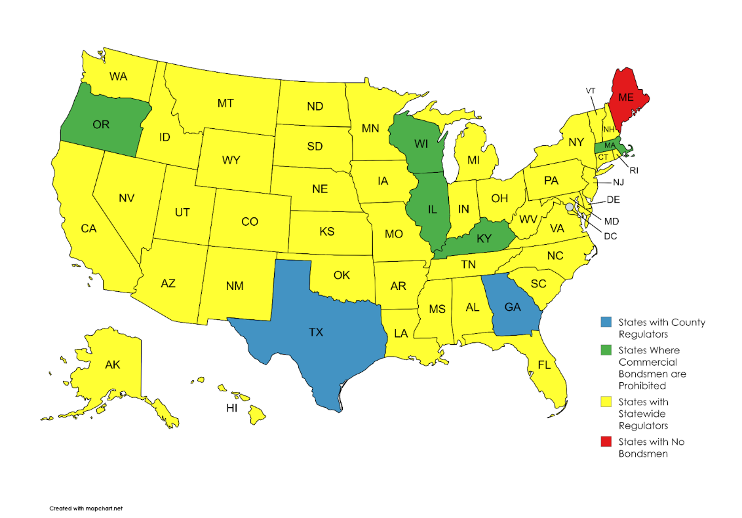
Note. Data from Bail Bond Agent Licensure, National Conference of State Legislatures, 2013. (https://documents.ncsl.org/wwwncsl/Criminal-Justice/Bail%20Bond%20Agent%20Licensure.pdf).
Recommendations
The Texas Legislature should transfer regulation of bail bond sureties and agents from local bail bond boards to the TDI by amending Chapter 1704, Occupations Code. The Department should be granted the authority to license and regulate bail bond professionals, adopt a set of uniform standards, investigate complaints, introduce financial and reporting requirements, and publish annual reports. This would abolish county bail bond boards and require the hiring of new full-time employees, likely incurring a substantial fiscal note. This fiscal note could, in part, be offset by licensing fees and is justified in improving forfeiture collection and reducing repeat offenders.
This reform effort would replace the current local regulatory structure with a consistent, statewide system better suited to the financial nature of bail bond underwriting. It improves the oversight of companies operating in multiple jurisdictions and strengthens accountability for unpaid bond forfeitures, misconduct, and public safety concerns.
In addition, the Legislature should require annual reporting on oversight and compliance (i.e., number of agents, number of denials, unsubstantiated and substantiated complaints, disciplinary actions taken), bond forfeiture satisfaction rates, failure to appear rates, fugitive recoveries, rearrest rates (by offense), and surety bond and personal bond outcomes.
Conclusion
The bail bond system in Texas serves a crucial purpose: to guarantee the promise of presumed innocence until proven guilty, ensure a defendant’s appearance in court, and to protect the public from further harm. However, current regulation is insufficient, inconsistent, and leaves gaps that could endanger public safety. By aligning regulatory oversight with the financial nature of the industry and establishing consistent statewide standards, Texas can preserve the constitutional right to bail, ensure those who profit from the system are held accountable for the risks they assume, and better ensure public safety for all Texans.
References
42 Pennsylvania Cons. Stat. Ch. 57. (2025). Bonds and recognizances. https://www.palegis.us/statutes/consolidated/view-statute?chpt=57&div=0&iFrame=true&ttl=42&txtType=HTM
Alabama Administrative Code Rule 153-X-3-.03 – Licenses. (n.d.).
https://admincode.legislature.state.al.us/administrative-code/153-X-3-.03
Alabama Code of Criminal Procedure § 15-13-159 Qualifications – Professional Surety Company. (n.d.). https://law.justia.com/codes/alabama/title-15/chapter-13/article-6/division-10/section-15-13-159/
Alabama Code of Criminal Procedure § 15-13-152 Qualification for Property Bail. https://codes.findlaw.com/al/title-15-criminal-procedure/al-code-sect-15-13-152/
Alabama Professional Bail Bonding Board. (n.d.). Alabama Professional Bail Bonding Board Law. Retrieved April 20, 2026, from https://www.apbbb.alabama.gov/
Alaska Stat. § 12.30.011. (2017). Release before trial. https://law.justia.com/codes/alaska/2017/title-12/chapter-30/section-12.30.011/
Alaska Stat. § 21.27.150. (n.d.). Limited licenses. Retrieved April 20, 2026, from https://law.justia.com/codes/alaska/title-21/chapter-27/article-1/section-21-27-150/
Carney, K. (2026). Texas Counties by Population. Texas Demographics.
https://www.texas-demographics.com/counties_by_population
Civic Federation. (2022). What Does the Elimination of Cash Bail Mean for Illinois Jurisdictions? https://www.civicfed.org/civic-federation/blog/what-does-elimination-cash-bail-mean-illinois-jurisdictions
Cohen, T. (2019). Bail bond industry fights back against moves to limit or end cash bail. Wisconsin Watch.
https://wisconsinwatch.org/2019/01/bail-bond-industry-fights-back-against-moves-to-limit-or-end-cash-bail/
Colorado Rev. Stat. Title 10, Article 23. (n.d.). Cash bonding agents. https://law.justia.com/codes/colorado/title-10/cash-bonding-agents/article-23/
Dallas Morning News Admin. (2011). Bail bondsmen owe Dallas County $35 million in uncollected default judgments. https://www.dallasnews.com/news/investigations/2011/07/03/bail-bondsmen-owe-dallas-county-35-million-in-uncollected-default-judgments/
Delaware Code Title 18, Ch. 43, Subch. II. (n.d.). Bail bond agents. https://delcode.delaware.gov/title18/c043/sc02/index.html
Garcia, G. (2017). Controversial bail bond operator again gets license renewed. The Houston Chronicle.
https://www.houstonchronicle.com/news/article/Controversial-bail-bond-operator-again-gets-11244567.php
Gideon v. Wainwright, 372 U.S. 335 (1963).
https://supreme.justia.com/cases/federal/us/372/335/
Harab, M., & DeBenedetto, P. (2022). Harris County officials set 10% bail bond minimum to limit people released from custody. Houston Public Media. https://www.houstonpublicmedia.org/articles/news/criminal-justice/2022/04/14/423234/harris-county-officials-set-10-bail-bond-minimum-to-limit-people-released-from-custody/
Harris County Office of County Administration. (n.d.). Harris County Bail Dashboard. Retrieved April 20, 2026, from https://app.powerbigov.us/view?r=eyJrIjoiNmU4MTczOTktMDdkMy00Nzk0LTgxMzMtYWU0YjQ0ZDU3NmY3IiwidCI6IjBkOWJjNzljLTU4MWItNDQ3Ny1hY2Y3LThkNzBkZDNlNTU1YSJ9
Idaho Department of Insurance. (n.d.). Bail agent. Retrieved April 20, 2026, from https://doi.idaho.gov/industry/licensing-services/license-types/bail-agent/
Idaho Code § 41-1038. (2010). Definitions. https://law.justia.com/codes/idaho/2010/title41/t41ch10sect41-1038.html
Illinois Courts. (2023). Illinois Supreme Court’s comprehensive preparations for the end of cash bail. https://www.illinoiscourts.gov/News/1279/Illinois-Supreme-Courts-comprehensive-preparations-for-the-end-of-cash-bail/news-detail/
Illinois Criminal Justice Information Authority. (2021). The 2021 SAFE-T Act: ICJIA roles and responsibilities. https://icjia.illinois.gov/researchhub/articles/the-2021-safe-t-act-icjia-roles-and-responsibilities
Kentucky Court of Justice. (n.d.). Pretrial services. Retrieved April 20, 2026, from https://www.kycourts.gov/Court-Programs/Pretrial-Services/Pages/default.aspx
Maine Revised Statutes Title 5, Ch. 105-A. (n.d.). Maine Bail Code. https://legislature.maine.gov/statutes/15/title15ch105-Asec0.html
Maine Revised Statutes Title 15, § 1071. (n.d.). Sureties to make statement of property.
https://legislature.maine.gov/statutes/15/title15sec1071.html
Maine Revised Statutes Title 15, § 1074. (n.d.). Property of defendant and 3rd parties as bail. https://legislature.maine.gov/statutes/15/title15sec1074.html
Marley, R. (2022). Harris Co. Bail Board passes motion requiring minimum 10% bond for certain violent crimes. FOX 26 Houston.
https://www.fox26houston.com/news/harris-co-bail-board-passes-motion-requiring-minimum-10-bond-for-violent-crimes
Massachusetts General Laws Ch. 276, § 58. (n.d.). Release on personal recognizance or unsecured appearance bond; determination; fees; refusal; petition for review. https://malegislature.gov/Laws/GeneralLaws/Partiv/Titleii/Chapter276/Section58
Miranda v. Arizona, 384 U.S. 436 (1966). https://supreme.justia.com/cases/federal/us/384/436/
National Conference of State Legislatures. (2013). Bail bond agent licensure. https://documents.ncsl.org/wwwncsl/Criminal-Justice/Bail%20Bond%20Agent%20Licensure.pdf
National Conference of State Legislatures. (2016). Pretrial Release Conditions. https://www.ncsl.org/civil-and-criminal-justice/pretrial-release-conditions
Nebraska Revised Statutes § 29-901. (2024). Bail; personal recognizance; appointment of counsel; conditions; pretrial release program. https://nebraskalegislature.gov/laws/statutes.php?statute=29-901
New Jersey Courts. (n.d.). Criminal justice reform. Retrieved April 20, 2026, from https://www.njcourts.gov/public/concerns/criminal-justice-reform
Office of the Attorney General of Texas. (2024). Annual Report of Forfeited Funds – 2024. https://www.texasattorneygeneral.gov/sites/default/files/files/divisions/criminal-justice/AnnualReportForfeitedFunds2024.pdf
Ohio Rev. Code § 3905.85. (2025). Surety bail bond agent license. https://codes.ohio.gov/ohio-revised-code/section-3905.85
Olsen, L. (2010). Bail bonds are big business, but not all pay up. The Houston Chronicle. https://www.chron.com/news/houston-texas/article/Bail-bonds-are-big-business-but-not-all-pay-up-1707202.php
Oregon Judicial Department. (n.d.). Security release (bail): Payments. Retrieved April 20, 2026, from https://www.courts.oregon.gov/courts/multnomah/payments/pages/bail.aspx
Professional Bondsmen of Texas. (n.d.). Texas County Bail Boards. Retrieved April 20, 2026, from
https://pbtx.com/bail-bond-boards
Reichert, J., Zivic, A., & Sheley, K. (2021). The 2021 SAFE-T Act: ICJIA Roles and Responsibilities. Illinois Criminal Justice Information Authority. https://icjia.illinois.gov/researchhub/articles/the-2021-safe-t-act-icjia-roles-and-responsibilities
Satija, N. (2025). As Greg Abbott blames crime on Harris County judges, the bail bond industry quietly profits. The Houston Chronicle. https://www.houstonchronicle.com/news/investigations/article/greg-abbott-bail-bond-industry-reform-20242369.php
Sawyer, W. (2022). All profit, no risk: How the bail industry exploits the legal system. Prison Policy Initiative. https://www.prisonpolicy.org/reports/bail.html
SB 383. Enrolled. 63rd Texas Legislature. Regular. 1973. https://lrl.texas.gov/LASDOCS/63R/SB383/SB383_63R.pdf
SB 2219. Introduced. 84th Texas Legislature. Regular. 2015.
https://capitol.texas.gov/tlodocs/89R/billtext/pdf/SB02219I.pdf
State of Nebraska Judicial Branch. (n.d.). Initial Court Appearances. Retrieved April 20, 2026, from https://nebraskajudicial.gov/reporters-guide-nebraska-trial-court-procedures/initial-court-appearances
State v. Epps, 36 Or. App. 519, 585 P.2d 425 (Or. Ct. App. 1978). https://law.justia.com/cases/oregon/court-of-appeals/1978/585-p-2d-425-0.html
Texas Almanac. (2010). Population history of counties from 1850–2010. https://www.texasalmanac.com/drupal-backup/images/topics/ctypophistweb2010.pdf
Texas Department of Insurance. (2026). Bond Resources. https://www.tdi.texas.gov/commercial/pcbond.html#:~:text=Occupations%20Code%2C%20Chapter%201704%20%2D%20Regulation,jurisdiction%20of%20the%20county%20sheriff
Texas Occupations Code § 1704.053. (n.d.).
https://statutes.capitol.texas.gov/?tab=1&code=OC&chapter=OC.1704&artSec=
Texas State Library and Archives Commission. (2017). United States and Texas Populations 1850-2017. https://www.tsl.texas.gov/ref/abouttx/census.html
Travis, A. (2020). Bail Reform in Kentucky: A Primer for Future Legislative Efforts. Texas Public Policy Foundation. https://www.texaspolicy.com/wp-content/uploads/2020/10/Bail-Reform-in-Kentucky.pdf
Wallace, R. (2022). Harris Co. Bail Bond Board renews license for one member of family-owned controversial bail bond company. Fox 26 Houston. https://www.fox26houston.com/news/harris-co-bail-bond-board-renews-license-for-one-member-of-family-owned-controversial-bail-bond-company
Wisconsin Stat. Ch. 969. (2026). Bail and other conditions of release. https://docs.legis.wisconsin.gov/statutes/statutes/969.pdf
World Population Review. (n.d.). Texas. Retrieved November 20, 2025, from
https://worldpopulationreview.com/states/texas
Appendix 1
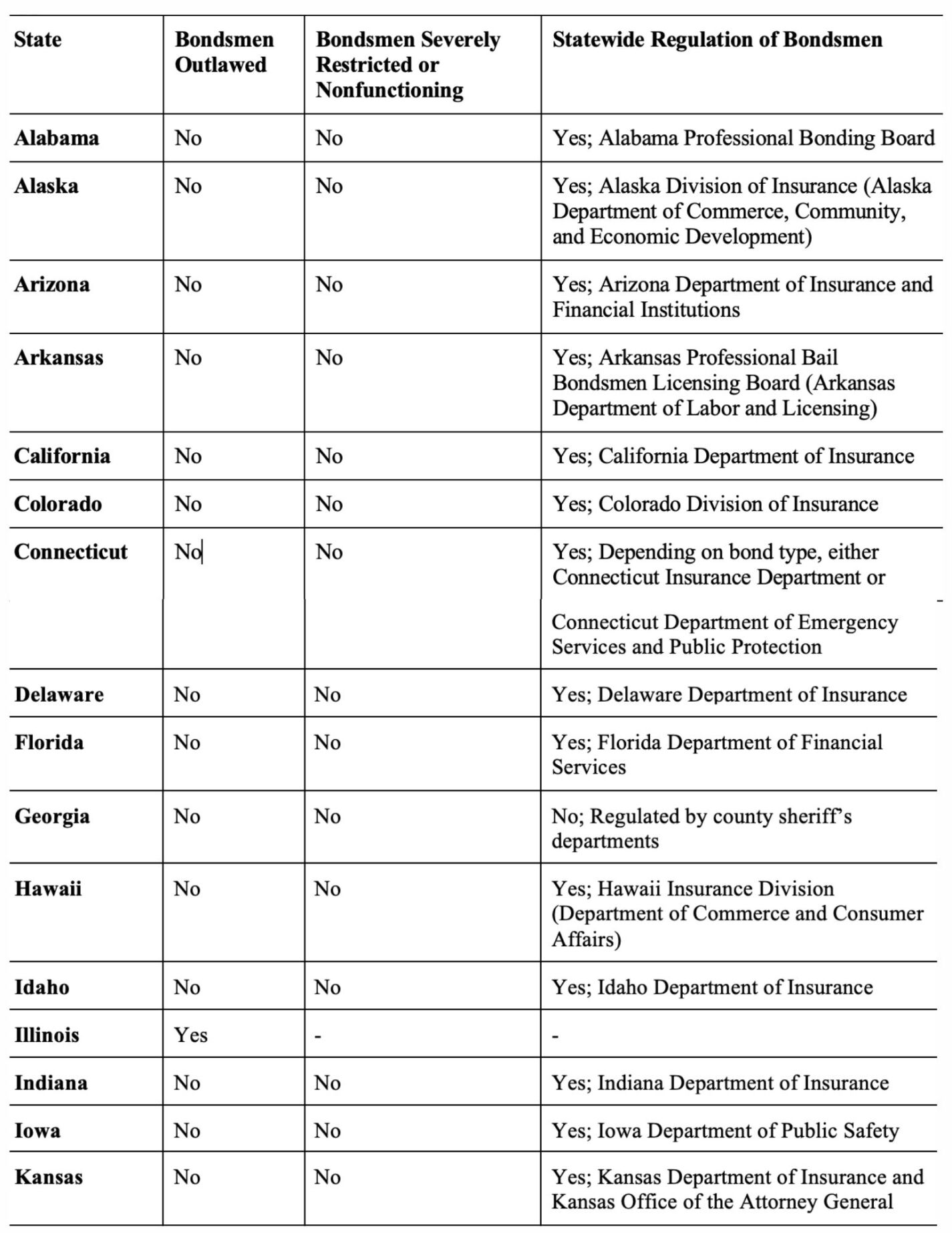
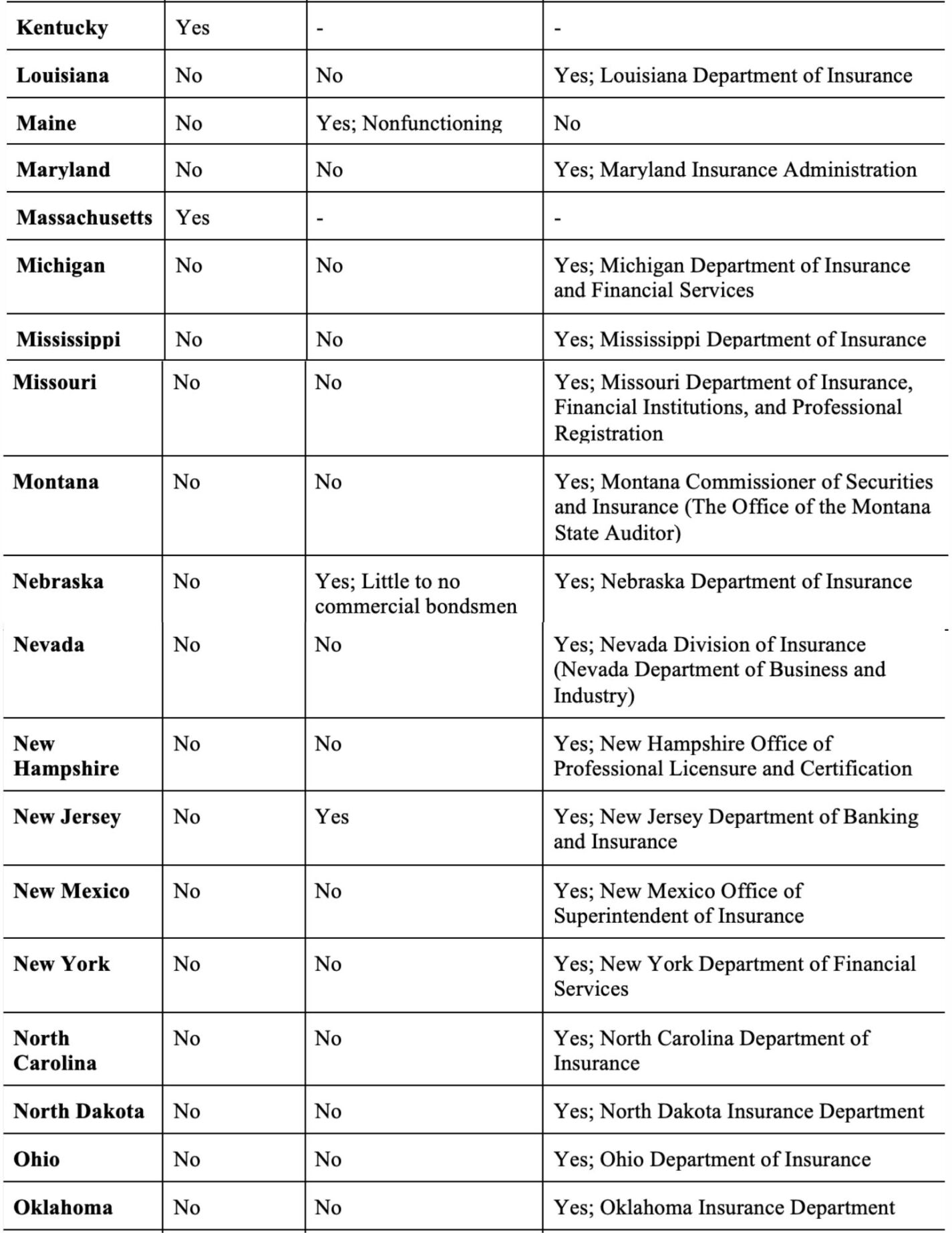
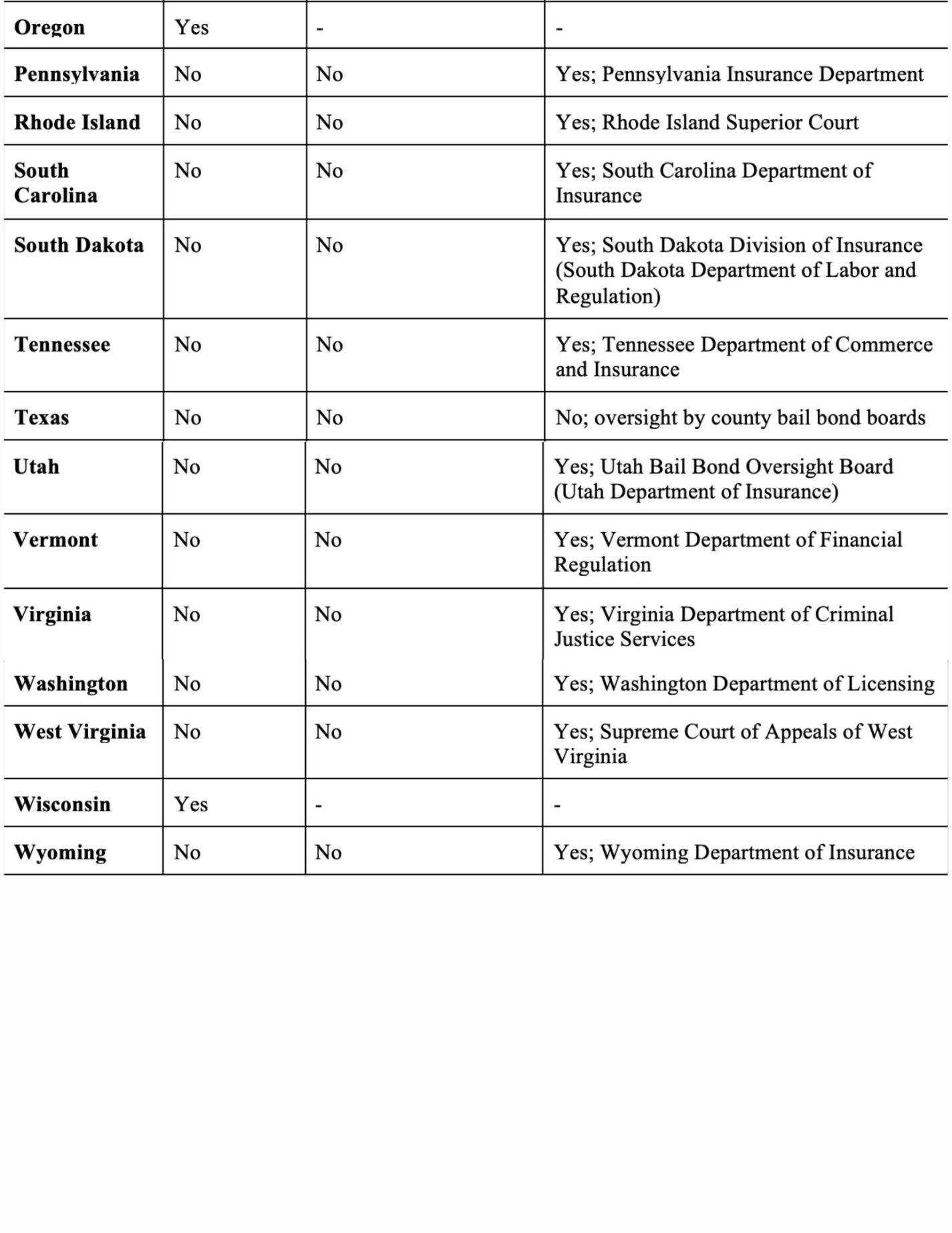
Note. Data from Bail Bond Agent Licensure, National Conference of State Legislatures, 2013. (https://documents.ncsl.org/wwwncsl/Criminal-Justice/Bail%20Bond%20Agent%20Licensure.pdf).