“You gotta get yourself in trouble to get attention.” That’s what a child told investigators looking into accusations of physical, sexual, and mental abuse happening behind the walls of youth detention centers run by the Texas Juvenile Justice Department. Videos and body camera footage (when not purposefully turned off) illustrated incidents of handcuffed children being disciplined with entire cans of pepper spray and days-long solitary confinement punctuated by retaliatory pushes, kicks, and punches by the adults charged with their care.
Just a month ago, the U.S. Department of Justice issued a scathing report about the state-run facilities of the Texas Juvenile Justice Department and TJJD officials quickly responded by denying the allegations. The DOJ report stated that TJJD “routinely violates the constitutional rights of children in all five facilities” through excessive force and isolation, failure to protect children from sexual abuse, and failing to provide adequate mental health services.
Research has shown us that juvenile offenders have a greater capacity for rehabilitation as they continue to reach developmental maturity when impulse control increases, and sensation-seeking behaviors decrease. With proper rehabilitation, youth can develop skills to rebuild their lives and become contributing members to society.
Excessive isolation and the lack of appropriate education and programming is failing to take advantage of a higher capacity for change. In 2023, TJJD reported that the three year re-offense rate for youth leaving secure facilities was at 71% and the re-incarceration rate was at 31%. By comparison, the three-year re-incarceration rate for adults in Texas is about 20%. Across the nation, states are facing the same issues and struggling to find answers.
Nationally, The First Step Act, bipartisan legislation passed under the Trump Administration, prohibits federal facilities from using solitary confinement as a form of punishment for youth for more than three hours, despite recent investigations showing kids spending upwards of 22 hours a day alone in their cells.
In detention facilities across the nation and in Texas, hiring and retaining staff is a challenge. The Texas legislature increased salaries in 2023 which initially helped with the recruitment of TJJD staff, however, that increase was followed by a staffing decline, and we’ve yet to reach that peak again.
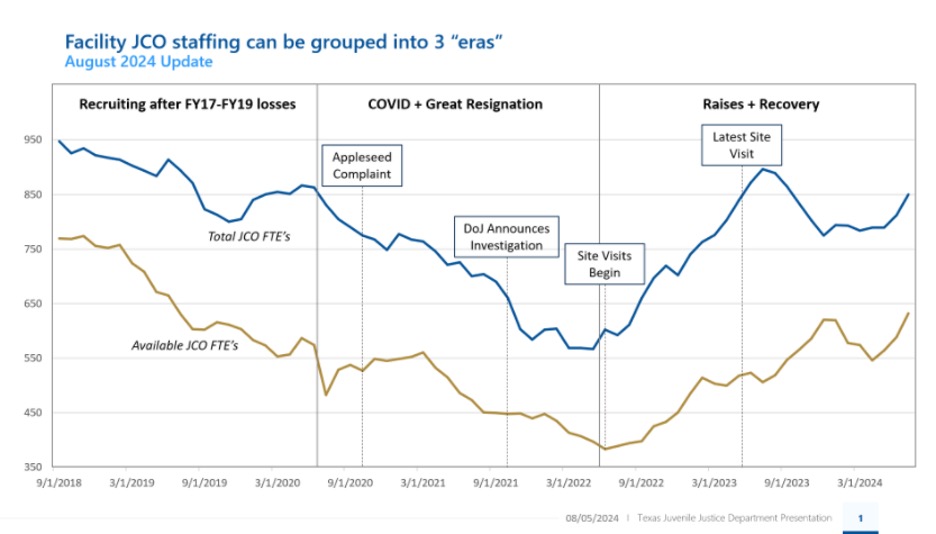
Recruiting and retaining staff is important when getting the ratios of juveniles to staff down to a safe level. Texas legislators have an opportunity to consider several solutions to ease the understaffing burden.
Most importantly, Texas must reexamine who is being committed and consider ways to limit those sent to TJJD. We should encourage counties to keep more youth shallow in the system by better utilizing our county facilities.
Texas must improve cross-county collaboration on a variety of criminal justice issues, including our juvenile justice system. Some suggest that we could leverage some of the larger counties with open beds and better staffing. While this solution may remove them from their home communities, it could also keep them shallower in the system and in more rehabilitative environments.
Examining the special commitment findings which detail a judges’ reasoning behind sending a juvenile to TJJD could help us better understand WHY kids are being committed. Is it a lack of county resources or are we locking youth up for punitive measures?
This is not a partisan issue. Texas legislators must work together to address excessive isolation, paring down the ongoing waitlist, and improving staffing issues in our juvenile detention centers. We can rehabilitate our youth before they are turned into hardened criminals by the inadequacies of our justice system.
Our children are our future, and if Texas is to continue taking children into custody through our juvenile justice system, we must accept responsibility to protect their basic constitutional rights and actively work toward rehabilitating them. Let’s give Texas kids every possible chance to turn their lives around and become contributing adults in our communities.